CBTF
Computer-Based Testing at UC Berkeley
We care about computer-based testing both because it is a key ingredient of scalable mastery learning and because it provides an important level of academic integrity for summative assessments. Read whichever background speaks to you most…
Mastery Learning
As far back as 1968, Benjamin Bloom and others recognized that if you give students schedule flexibility when working through material (since some students learn certain concepts faster than others) and multiple opportunities to practice (and to demonstrate mastery, such as through second-chance or re-take exams), you can narrow learning and achievement gaps among those students — particularly important when some of them may come from socioeconomically disadvantaged backgrounds. This approach is called mastery learning, and computer-based testing allows us to effect some important ingredients of it economically at scale.AI
So much for honor codes: The AI "cheating crisis" is real, and some have suggested going back to proctored exams and handwritten blue books. Yes to human proctors! But UIUC professor Craig Zilles and I strongly disagree that going back to "blue books" is a good idea: Advances in technology make computer-based testing a far superior alternative.
Inspired by the work pioneered at the University of Illinois, Dan
Garcia and I
became the faculty leads for developing Computer-Based Testing at UC
Berkeley, including onboarding new faculty, (cheer)leading the
efforts to establish computer-based testing facilities (CBTFs) on
campus, showing the benefits achieved through mastery learning and accessibility as
well as academic integrity, and even teaching students how to create
and evaluate rich authentic assessments that
work with PrairieLearn.
The CBTF is a keystone component of the larger Golden Bear Testing Centers initiative overseen by the Division of Undergraduate Education.
Short Reads
-
Craig Zilles and Armando Fox, Blue Books Are Not the Answer to the AI Cheating Crisis. Inside Higher Ed, 2026-03-19. Why you shouldn’t conflate “proctored exams” with “blue book exams,” and why computer-based testing is far superior to blue books in most cases.
-
Armando Fox and Craig Zilles, Scalable Exam Administration: The Proctoring Crisis Requires a SEA Change, submitted to Communications of the ACM. The key ingredient to scalable exam administration: not all students take the exam simultaneously. This entails three other requirements: no real-time answers to clarifying questions, no paper cheatsheets, uniform-length exam slots. Once you take on board “not simultaneous,” the other derived requirements follow. Here’s why non-simultaneous is key to scalability, and how you meet both that requirement and the derived ones.
-
Armando Fox, Bootstrapping a Computer-Based Testing Facility Using Shared Lab Space. An experience report of growing our CBTF efforts from 230 student in 1 course using shared lab space to over 5,500 students in over 20 courses using a dedicated 100-seat facility.
Updates
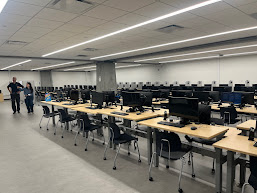
On Monday, August 31, 2026, UC Berkeley’s brand-new 100-seat CBTF in the remodeled Moffitt Library went into production!
This is a major milestone for us. It was only in Fall 2023 that we tried a pilot of a “proto-CBTF” using shared lab space and serving a single ~230-student course for a final exam only. As of August 2026, the newly-opening CBTF has already scheduled nearly 40,000 student-exam-hours across more than 20 courses for Fall 2026.
This SIGCSE Virtual 2026 paper discusses that bootstrapping process and lessons learned, and should persuade you that you can do this at your institution too, without boiling the ocean all at once. The latter was not a foregone conclusion, given that we heavily modeled our approach on that developed organically over several years at the University of Illinois and other institutions.